

Lawn Mowing Service near Me Price: What You Should Pay
A lawn mowing service near me price is what a local crew charges to mow, trim, edge, and blow off your yard in a single visit. For a typical suburban lot of 1/8 to 1/4 acre on a weekly schedule, expect roughly $30 to $65 per cut. Published rates for Columbia put most cuts between $35 and $50. Larger lots, overgrown grass, and one-time visits cost more.
This guide explains why that number matters, what per-cut prices look like by yard size and frequency, and which factors move your quote in the Midlands. You will also learn how to measure your lawn, how to request a quote that comes back accurate, how to compare bids, and how to budget for a full year of mowing and lawn care.
We are Sparta Lawn Care, a veteran-owned and locally owned company serving Columbia, Blythewood, Elgin, and the surrounding Midlands for more than 20 years. We price and mow lawns every week, so the guidance below reflects how mowing quotes are actually built.
Why knowing the going rate for mowing matters
Knowing the going rate matters because it is the only way to tell a fair quote from one that costs you money, quality, or protection. Any lawn mowing service near me price you find online is a benchmark, not a promise. A benchmark is still enough to spot a quote that is far too high or suspiciously low.
Overpaying and underpaying both cost you
Overpaying is the obvious risk. A crew that quotes $85 for a 1/8-acre lot is charging more than double the usual $30 to $40 for that size, and you would never know without a reference point. Underpaying is the quieter risk. A crew that mows a quarter-acre lawn for $20 is saving money somewhere, usually on insurance, equipment, trimming time, or the reliability of next week's visit.
That last point deserves attention. A mower can throw a rock through a window or a windshield in a second. A licensed and insured company pays for that damage. A one-person operation with no coverage may not, and you could end up filing a claim on your own homeowner's policy. Part of a fair price is the cost of that protection.
A fair mowing price is the one that covers the work, the equipment, and the insurance behind it.
What a per-cut price should include
A standard per-cut price covers the whole visit, not just the mower pass. Most residential quotes include these tasks:
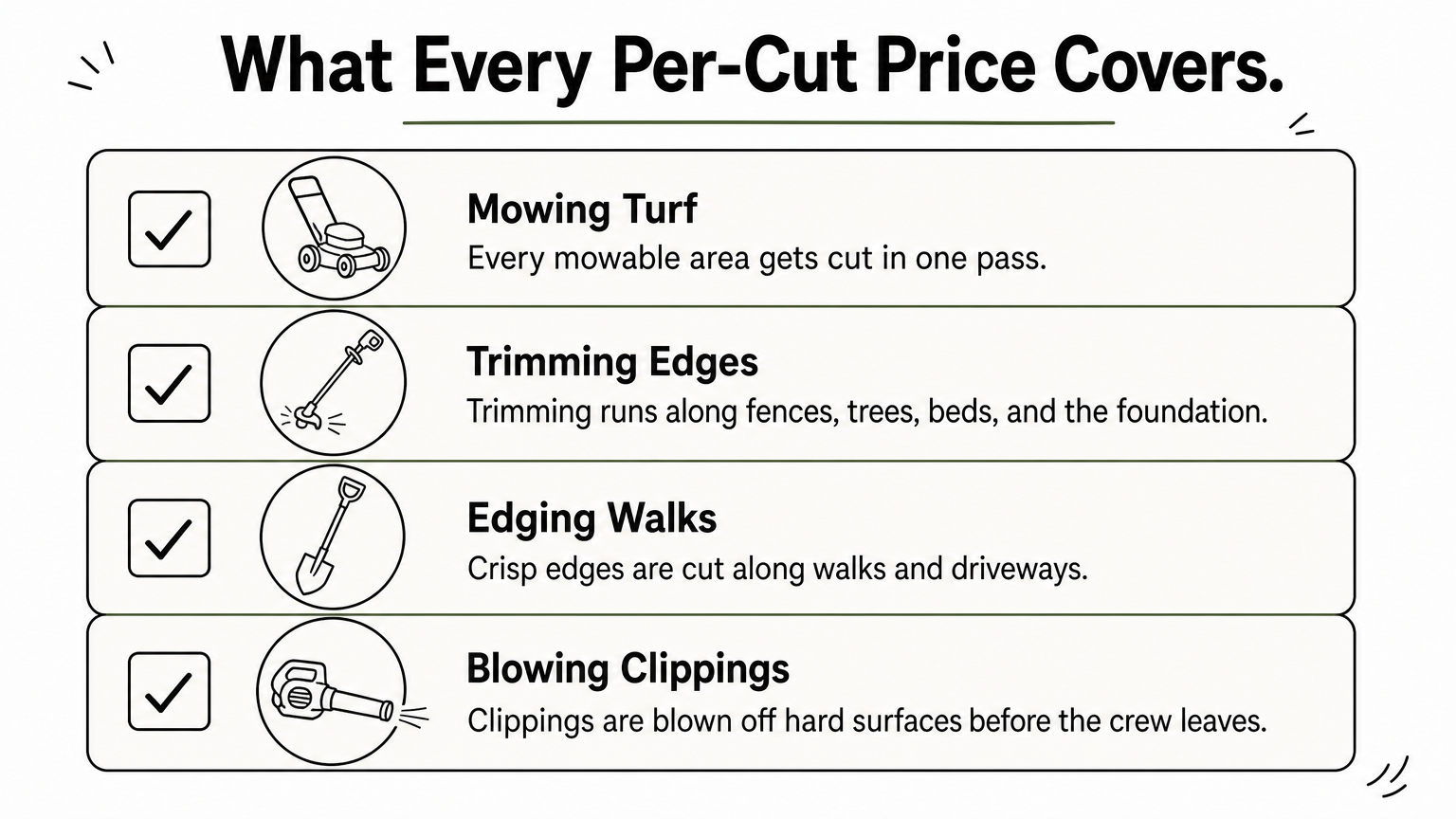
- Mowing all turf areas
- Trimming along fences, trees, beds, and the foundation
- Edging along walks and driveways
- Blowing clippings off hard surfaces
Extras are usually priced separately. Bagging and hauling clippings, bed weeding, leaf removal, hedge trimming, and fertilizer or weed treatments all fall outside a basic cut. Two quotes are only comparable when they list the same tasks. A $35 cut with no edging or blowing is not cheaper than a $42 cut that includes both.
What lawn mowing costs per cut, by yard size
Most homeowners pay $30 to $85 per cut for a 1/8 to 1/4 acre lawn on a recurring schedule. The price climbs with lot size and with the gap between visits. The numbers below separate those two effects so you can find your own row.
Per-cut prices by yard size and frequency
The table shows typical recurring prices per visit for residential lawns, based on national figures. Less frequent service costs more per cut because the grass is taller and takes longer to cut.
| Yard size | Weekly | Every two weeks | Every four weeks |
|---|---|---|---|
| 1/8 acre (about 5,445 sq ft) | $30 to $40 | $40 to $50 | $50 to $60 |
| 1/4 acre (about 10,890 sq ft) | $45 to $65 | $60 to $85 | $70 to $100 |
| 1/2 acre (about 21,780 sq ft) | $50 to $75 | $65 to $100 | $80 to $120 |
| 1 acre (about 43,560 sq ft) | $60 to $100 | $80 to $150 | $95 to $180 |
Two caveats apply. One-time visits typically cost 50% to 100% more than recurring service, because the crew gets no route efficiency and no ongoing relationship. An overgrown lawn costs more again, often $70 to $150 for the first cleanup cut, since the crew may need two passes and extra time to deal with clippings.
Hourly, per-acre, and per-square-foot rates
Some companies skip the per-visit price and bill by time or area. Each method suits a different kind of lot.
| Billing method | Typical mowing rate | Best fit |
|---|---|---|
| Per hour, per worker | $25 to $80 | Lots with trees, fences, play sets, or slopes |
| Per acre | $60 to $200 | Large, open lots mowed with a riding mower |
| Per square foot | $0.01 to $0.05 | Small, easy-to-measure yards |
The per-acre range is wide because pricing guides disagree. The lower end reflects recurring service on flat, open ground. The higher end reflects one-time visits, slopes, and the fuel and equipment cost of riding mowers. If a company quotes per hour, ask how long they expect your lawn to take, so you can turn the rate into a per-cut price.
Why published prices disagree
Online guides publish different averages. Some say $42 to $68 per visit, others say $30 to $85 for a standard lot, and one gives $75 to $200 per visit with a national average of $130. The highest figure describes a broader lawn care visit that bundles cleanup, trimming, and clippings removal, often on larger lawns. It is not a plain mowing price.
Local quotes are the best check. Published rates for Columbia put most cuts at $35 to $50, which sits in the lower half of the national band. That fits a region where many lots are small to mid-sized and crews can stack several stops on one street.
Compare per-cut prices only when the yard size, frequency, and included tasks match.
What drives your price up or down in the Midlands
Lot size sets the baseline, but layout, grass type, season, and lawn condition decide where in the range you land. A lawn mowing service near me price quoted without those details is an estimate, not a bid.
Lot size, layout, and obstacles
Mowing is priced mostly by time on your property. A flat, open quarter acre may take 25 minutes with a wide mower. The same quarter acre cut up by flower beds, a play set, mature trees, and a fenced backyard can take twice as long. Obstacles slow the crew and push the price toward the top of the range.
Access matters as well. A gate too narrow for a ride-on mower forces the crew to use a push mower. A steep slope needs slower, careful passes, and slopes near a ditch or a pond add risk. Tell the provider about these details up front. Surprises on the first visit usually turn into a higher price on the second.
Grass type and the Midlands growing season
Most Midlands lawns are warm-season grasses such as Bermuda, zoysia, and centipede. These grow hardest in the heat of summer, so weekly mowing from late spring through summer is the norm. Growth slows in fall and stops when the grass goes dormant after frost. Some lawns, especially shaded ones, are tall fescue. It is a cool-season grass that peaks in spring and fall and struggles in summer heat.
| Grass | Season type | Typical cut height | Mowing rhythm |
|---|---|---|---|
| Bermuda | Warm-season | 0.5 to 2 inches | Weekly in summer |
| Zoysia | Warm-season | 1 to 2.5 inches | Weekly in summer |
| Centipede | Warm-season | 1 to 1.5 inches | Weekly in summer |
| Tall fescue | Cool-season | 3 to 4 inches | Busiest in spring and fall |
Frequency shapes your annual cost more than the per-cut price does. Bermuda cut short and often means more visits per season than fescue left tall. Ask whether the company prices by the season or by the visit, and how it handles the slow months at each end of the year.
Condition, access, and surcharges
Beyond size and grass, several smaller items change the bill:
- Overgrown grass. Expect a higher first-visit price if the lawn has gone weeks without a cut.
- Debris. Sticks, acorns, pet waste, and toys slow the crew down. Clear them before they arrive.
- Travel. Properties outside a company's regular routes can carry a travel fee.
- Fuel. Some companies add a temporary surcharge when gas prices spike.
- Neighbors. Several adjacent customers on the same route can bring discounts, because the crew saves drive time.
- Prepayment. Paying for a season up front often earns a 3% to 10% discount.
Time on your property, not acreage alone, is what a mowing crew is really selling.
How to get an accurate mowing quote for your yard
To get an accurate quote, give the provider your mowable square footage, grass type, and access details before they price it. A quote built on a guess about your lot is a quote that changes later. Five minutes of prep makes the first number the final number.
Measure your mowable lawn in five minutes
You only need a rough number for the turf the crew will actually cut. Follow these steps:

- Open Google Maps in satellite view and use the measure distance tool, or walk the yard with a tape or a measuring wheel.
- Split the lawn into rectangles: front yard, back yard, side strips.
- Multiply length by width for each rectangle, then add the results.
- Subtract areas that do not get mowed, such as the house footprint, driveway, patio, and large planting beds.
- Round to the nearest hundred square feet.
For example, a 50 by 40 foot front yard is 2,000 sq ft. A 60 by 45 foot backyard is 2,700 sq ft. Two side strips at 10 by 30 feet add 600 sq ft. The total is 5,300 sq ft, which is close to 1/8 acre. Use the table above to see which price row you belong in.
What to tell the provider
Providers price faster and more accurately when you send everything in one message. Copy and adapt this template:
 Hi, I'm looking for recurring lawn mowing at [address].

Mowable lawn: about [X] square feet
Grass type: [Bermuda / zoysia / centipede / fescue / not sure]
Access: [fenced yard? gate width? slopes? pets?]
Obstacles: [trees, play set, many beds, etc.]

Please quote:
1. Weekly price per visit
2. Every-other-week price per visit
3. One-time price

Please confirm:
- Does the price include trimming, edging, and blowing?
- Do you bag or haul clippings, and is that extra?
- Do you carry liability insurance? Can you send proof?
- What happens if rain delays a visit?
- How and when do you bill?
Ask for three prices, not one. The gap between weekly and every-other-week pricing tells you how the company thinks about your lawn. A quote that is identical for both frequencies usually means a flat monthly fee. A big gap means they price strictly per visit. Either is fine, but you should know which one you are signing up for.
A quote is only as accurate as the lawn details behind it, so measure first and ask second.
How to compare quotes and spot a bad deal
Compare quotes by the price per cut at the same frequency, by what each quote includes, and by what protects you if something goes wrong. The lowest number is rarely the best value. Line every bid up on the same terms before you decide.
Line up quotes on the same terms
Fill in a simple grid for each provider. These are the terms that matter most:
| What to compare | Why it matters |
|---|---|
| Price per cut at the same frequency | Prevents comparing weekly to monthly prices |
| Tasks included | Trimming, edging, and blowing add real time |
| Clippings handling | Bagging and hauling are often extra |
| Insurance and license | Protects you from damage claims |
| Weather policy | Tells you how rain delays are handled |
| Contract and cancellation terms | Lets you leave if service slips |
| Billing method | Per visit, monthly, or prepaid changes cash flow |
Set the two or three closest bids side by side. If one is $8 lower but leaves out edging and blowing, you are not saving $8. You are buying a different service.
Red flags and signs of a fair price
Some warning signs show up again and again with mowing bids:
- A price well below the typical range for your lot size, with no explanation
- No proof of insurance when you ask for it
- A request to pay a full season in cash before the first cut
- Vague answers about what is included
- A crew that changes from week to week, so nobody knows your yard
Prepay only after a trial season. A 3% to 10% prepayment discount is common and can be a fair deal with a company you already trust. It is not worth the risk with a stranger.
Fair prices tend to come with specifics. The company names the tasks, explains the frequency, shows insurance, and offers a written guarantee. At Sparta Lawn Care we send consistent crews to each property and back the work with the Sparta Family Guarantee. We fix any service issue at no extra cost until you are satisfied. Ask every provider what their equivalent is.
The cheapest quote is a bargain only if the work, the insurance, and the schedule hold up.
How to budget for mowing and lawn care all year
Plan on roughly $900 to $2,000 per year for mowing a typical 1/8 to 1/4 acre lawn, and more if you add treatments. The exact figure depends on frequency, season length, and whether you stay with mowing alone.
A worked season budget
Use the quarter-acre rows from the price table and assume 30 mowing weeks across the Midlands growing season. Weekly service at roughly $55 per cut comes to about $1,650. Every-other-week service at roughly $72 per cut means 15 visits and about $1,090. That is a saving of more than $500 per season.
Cutting less often saves money but costs you lawn quality. In peak summer growth, a two-week gap lets the grass grow past the height it should be cut at one time. Removing too much blade at once stresses the lawn and leaves clumps. Weekly cuts in summer and every-other-week cuts in the slow shoulder months is a sensible split for most warm-season lawns.
Mowing versus full-service lawn care
Mowing keeps a lawn tidy. It does not feed, weed, or repair it. Many homeowners add treatments once the basics are handled, and bundles usually cost less than buying each service separately.
| Service | Typical price | Notes |
|---|---|---|
| Fertilizing | $65 to $100 per treatment | Most important in spring and fall |
| Weed control | $50 to $125 per treatment | Often bundled with fertilizer |
| Aeration | $75 to $250 per visit | Typically every 1 to 3 years |
| Dethatching | $75 to $300 per visit | Only when thatch builds up |
| Overseeding | $0.04 to $0.18 per sq ft | Timing depends on grass type |
| Full-service plan | $100 to $400 per month | For a 1/8 to 1/4 acre lawn |
Timing depends on your grass. Warm-season lawns are typically aerated in late spring or early summer, while fescue is usually overseeded in fall. We handle fertilization and weed control treatments, aeration, and overseeding alongside mowing, which keeps one crew and one invoice for the whole lawn.
Hiring versus mowing it yourself
A push mower costs $100 to $500 and a riding mower $1,800 to $5,000. At $55 per weekly cut, a $400 push mower pays for itself in about eight visits, before fuel, blades, a trimmer, a blower, storage, and your own time. If you have a small yard and like the work, doing it yourself is cheaper. If your weekends are full, or your lot needs a riding mower, hiring costs less than it first appears.
Mowing alone fits most budgets, and the right add-on is the one your grass type needs this season.
Know your number before you ask for a quote
A fair mowing price depends on four things: your lot size, your visit frequency, what the visit includes, and the protection the company carries. For a typical Midlands yard, that works out to about $30 to $65 per weekly cut, with local rates in Columbia commonly between $35 and $50. Measure your lawn, ask for weekly, every-other-week, and one-time prices, and compare bids on identical terms.
If you want a quote built on your actual lot, request a mowing quote from Sparta Lawn Care. Tell us your address and your grass type, and we will give you a clear per-cut price with the work and the guarantee spelled out.